
How loud is a heat pump or air conditioning outdoor unit?
Most heat pump and air conditioning outdoor units make about 40 to 60 dB(A), according to Daikin, which is in the same range as a fridge, a dishwasher or a washing machine. What you hear is a low hum from the compressor and the rush of the fan. Where the unit goes matters more than small differences between models: distance, nearby walls and your neighbour's nearest window all change what anyone actually hears. In England, a heat pump fitted without a planning application must pass a noise test that keeps it at 37 dB(A) or below at that window.
Typical sound levels
How decibels work, in plain words
Decibels are not like centimetres on a ruler, where 60 is simply twice 30. The scale climbs quickly, and dB(A) means the reading is weighted to match how people actually hear.
- 3 dB more
- About the smallest change most people notice
- 10 dB more
- Sounds roughly twice as loud
- Twice as far away
- About 6 dB quieter, in open air with nothing for the sound to bounce off
- 30 dB
- Someone whispering close to your ear
- 40 dB
- A quiet room
- 60 dB
- Normal conversation
Sound power and sound pressure are not the same
Data sheets often give two figures, and comparing the wrong ones is the most common mistake.
Sound power
- The total sound the unit gives out
- Does not change with distance
- The figure the official noise test has to use
Sound pressure
- What you actually hear at a given spot
- Falls the further away you are
- Usually quoted at 1 metre or a few metres away
The same small Daikin unit is 60 dB(A) as sound power but 46 dB(A) as sound pressure, so always check you are comparing like with like.
The noise rule for heat pumps in England
Since 29 May 2025, a heat pump fitted in England under permitted development (without applying for planning permission) must meet MCS 020(a), the industry's noise calculation, whether or not the installer is MCS certified. Under the current rules:
- The heat pump must be 37 dB(A) or below at the nearest window of a habitable room next door, worked out with the MCS method.
- The old rule that it had to be at least 1 metre from the boundary has gone. The noise test decides instead.
- A detached house can have two units. Other houses can have one.
- Each unit can be up to 1.5 cubic metres on a house.
- Systems that heat as well as cool now count, which brings air to air heat pumps in. Air conditioning that only cools does not.
- Listed buildings, some conservation areas and some flats still need planning permission.
Scotland, Wales and Northern Ireland still use the older MCS 020 method, so the rules there are different.
Why the limit went from 42 to 37
The old test allowed 42 dB(A) but added an assumed background noise. The new test leaves the background out and sets 37 dB(A) for the heat pump on its own.
MCS made the change after consultation, saying the heat pump's own sound level gives a more accurate result. You will still see 42 dB(A) quoted in older articles.
Where to put an outdoor unit
- Keep it away from bedrooms, both yours and next door's. Distance is the biggest single help.
- Avoid tight corners and alcoves. Hard surfaces close to the unit bounce sound back and push the noise result up.
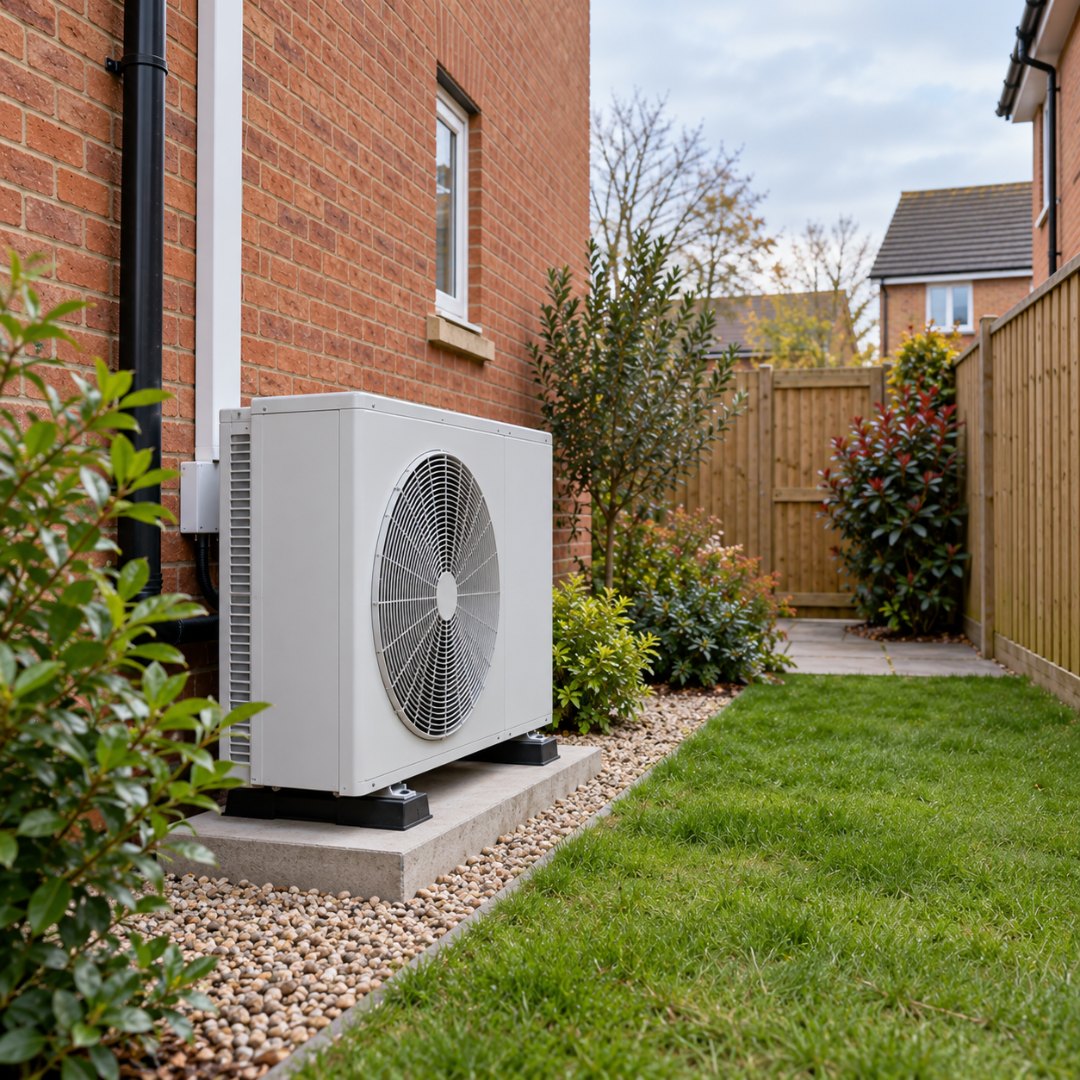
- Fix it to a solid base or bracket with anti-vibration feet or mounts, so the hum does not travel into the wall.
- Keep the air path clear of fences, bins and plants, so the fan does not have to work harder.
- A solid wall or fence between the unit and the neighbour's window can help, if it meets the standard's definition of a barrier.
- Use the quiet or night mode if the unit has one. Daikin's night quiet mode cuts about 3 dB(A).
Noises that are normal, and ones that are not
How Nord Group plans a quiet install
Nord Group brings air conditioning and heat pumps together. ArcticNord fits air conditioning, installed by F-Gas registered engineers, and AuraNord fits air source heat pumps.
- Step 1
A survey
We look at where the outdoor unit can go, how far it is from your bedrooms and your neighbours' windows, and any walls or fences in between.
- Step 2
The noise check
For a heat pump fitted without a planning application, the MCS 020(a) calculation is done before anything is ordered.
- Step 3
A written quote
Agreed with you before any work begins.
- Step 4
Fitted properly
On a solid base or bracket with anti-vibration mounts, and set up to run quietly.
Want to know where a unit could go at your home? Book your free survey with ArcticNord for air conditioning or AuraNord for an air source heat pump. Not sure yet? Call Nord Group on 0333 090 7546 and we will help you work out where to start.
Book a surveyQuestions people ask
How loud is a heat pump in decibels?
Most heat pump and air conditioning outdoor units run at about 40 to 60 dB(A) close up, according to Daikin. That is similar to a fridge, a dishwasher or a washing machine.
How close can a heat pump be to my neighbour's house?
In England there has been no fixed distance since 29 May 2025. Instead, the heat pump must be 37 dB(A) or below at the neighbour's nearest habitable room window, worked out with the MCS 020(a) method.
Do I need planning permission for air conditioning?
In England, a system that heats as well as cools can now be fitted under permitted development, as long as it meets the conditions, including the noise test. Air conditioning that only cools is not covered, so check with your council.
Is an air conditioning unit louder than a heat pump?
Not as a rule. Both sit in the same broad range, and the size of the unit and where it goes make more difference. Compare the sound power figures from the data sheets.
Will an outdoor unit keep me awake?
Not if it is placed well. Keep it away from bedroom windows, mount it on anti-vibration feet and use the night quiet mode if the unit has one.
Where these facts come from
- Most outdoor units about 40 to 60 dBA sound pressure measured 1 to 5 m away, fridge 30 to 50, dishwasher 45 to 55, washing machine 50 to 60,…checked 2026-10-24
- Daikin RXP25M (Comfora 2.5 kW outdoor unit) data sheet, merchant copy: sound power 60 dBA, sound pressure 46 dBA coolingchecked 2026-10-24
- 3 dB is about the smallest noticeable change, 10 dB sounds twice as loud, everyday levels: 30 dB whispering, 40 dB quiet, 60 dB normal speec…checked 2026-10-24
- Sound drops about 6 dB for every doubling of distance from a point source in a free fieldchecked 2026-10-24
- New permitted development rules from 29 May 2025: within 1 m of the boundary, 1.5 cubic metres, two units on detached houses, air to air inc…checked 2026-10-24
- MCS 020(a) limit changes from 42 dB(A) to 37 dB(A) by removing the assumed background noise stepschecked 2026-10-24
- Permitted development conditions: 37 dB(A) at nearest habitable room, one per house or two on detached, 1.5 cubic metres, listed buildings, …checked 2026-10-24
- MCS 020(a) uses sound power, not sound pressure; reflective surfaces within a metre increase the result; acoustic barrierschecked 2026-10-24